
Women’s History Month Feature: A Conversation with Linda Lee Alter
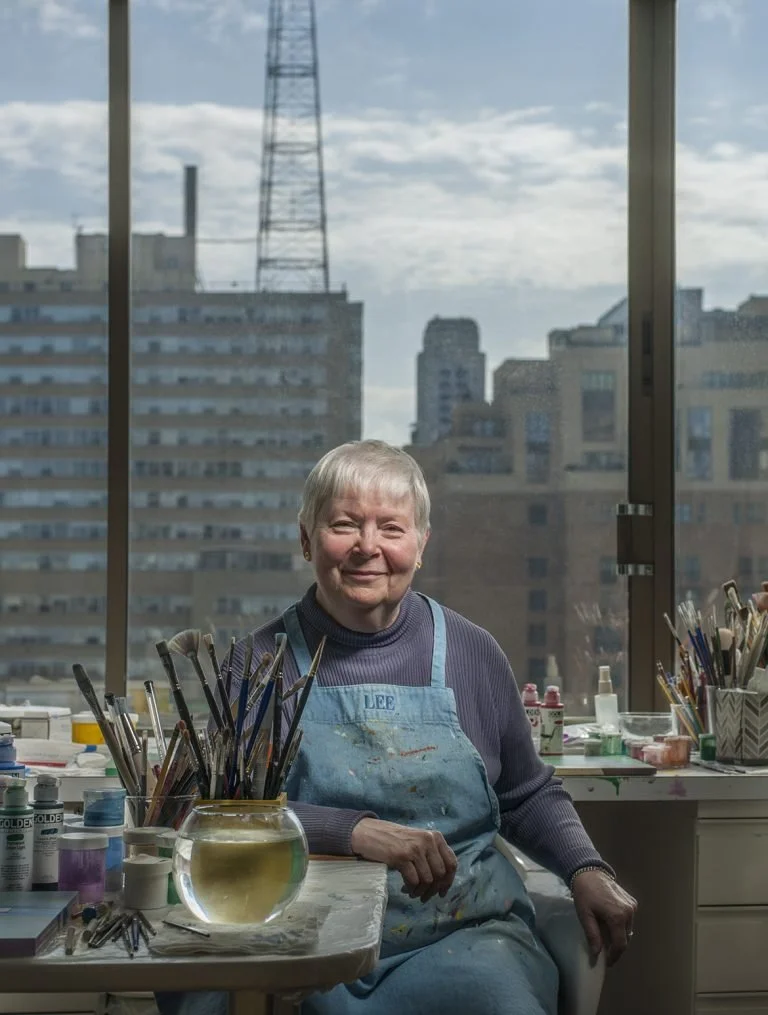
Photo: Linda Lee Alter in her studio, © Dave Moser Photography LLC
This Women’s History Month, Jake Foster, our Art Exhibitions Manager, sat down for a conversation via Zoom with someone who has been an ardent supporter of women artists in Philadelphia for decades; artist and collector Linda Lee Alter, who goes by Lee. Lee has been a fine artist for more than 60 years. She has taught arts and crafts, worked as a commercial artist and illustrator, exhibited in galleries and museums, and has artwork in many private and public collections.
In the 1980s, she started collecting art by women after realizing that women are severely underrepresented in museum collections. In 2010, she gave this collection to the Pennsylvania Academy of the Fine Arts to establish the Linda Lee Alter Collection of Art by Women, which includes over 500 works (including artists such as Louise Bourgeois, Kiki Smith, Ana Mendieta, Christina Ramberg, Kara Walker, Faith Ringgold, Alice Neel, Louise Nevelson, Betye Saar, and Alison Saar, to name a few), as well as many outstanding, less-well-recognized, women artists - many of them local.
In 1991, Lee founded the Leeway Foundation to make grants to women and trans artists living in the greater Philadelphia region. Today, Leeway is a community-led, grant making foundation that supports women and trans artists and cultural producers working in communities at the intersection of art, culture, and social change.
Without Lee, there would be a substantial lack of support for women artists in our region. In our interview, Lee discusses her early artwork—and even shows us over Zoom a drawing from the 1st grade and a self-portrait completed at 17. We learn about her educational background in art education and art psychotherapy. And in addition to discussing her collection and the Leeway Foundation, we also talk about the role of the artist in times of protest, and her coming out in 2014 and subsequently finding community at the William Way LGBT Community Center.
JF: I thought we’d begin in the 1960s and 70s, with your background in art education and psychotherapy. My educational background is in studio practice, but I think people who have backgrounds such as yours have a greater appreciation for art’s ability to be useful tools for education, personal reflection, and mental health. Can you tell us a bit about your studies? Do you think they played a role in preparing you for what you would later do in your life?
LLA: Well, it started out a little earlier than that. I was programmed to be a teacher. My mother taught first grade for 35 years. That's a lot of years! And my father taught “shop” in several Philadelphia high schools, where he taught about tools, electricity, and building things for a number of years before he started his own business.
I was expected to be a teacher too, because it was a safe, secure, respectable job for a woman in the 1950s and 1960s. The theory was you could teach until you got married and had kids, then if you ever needed to have a job, you could go back. I began my studies at the Philadelphia College of Art before it was a college—it was the Philadelphia School of Art—and it became an accredited college during my four years there. So that was interesting.
And of course, I took the art education course because that’s what I was programmed to do. I graduated and taught for a year at Bartram High School. I was married by then. I got married at 18 (which did not thrill my parents). We moved to St. Louis for my husband’s medical training, and after that, we moved around for several years because it was the time of the Vietnam War. As a medical doctor, he was able to join the Public Health Service, instead of having to serve in the armed services. Along the way, we lived in Atlanta, Puerto Rico, and Boston. And then we returned to Philadelphia, where I was born and grew up, and I've stayed here since. Do you want to know about where I worked?
JF: Yes, absolutely!
LLA: I worked at a photography center in a department store, an artist for a public TV station, and in a store display department. After returning to Philly, I did freelance illustration for a while before giving birth to our daughter, Sara Milly. Afterwards, I stayed home to raise Sara. During that time, I also focused on creating fabric appliqué wall hangings, which I continued to do for 30 years. One summer, I had the fun and pleasure of participating in the Rittenhouse Square Art Fair.
When Sara was about five years old, I went back to school to study Art Psychotherapy. In addition to learning ways to help understand people who are experiencing mental and emotional difficulties and how to help people express themselves through their art, the training helped me to more fully recognize how my own personal history and feelings were reflected in my own art. I knew it, and my artwork has always had messages, even when I was a small child, but the training really helped me to see more in it. My mother—and I'm very thankful to her—saved the first drawing I did on my first day of first grade. Did I have that on the website?
JF: No, I don't think so.
LLA: I had it framed years ago. Here it is. Can you see it?
JF: Oh my gosh, wow.
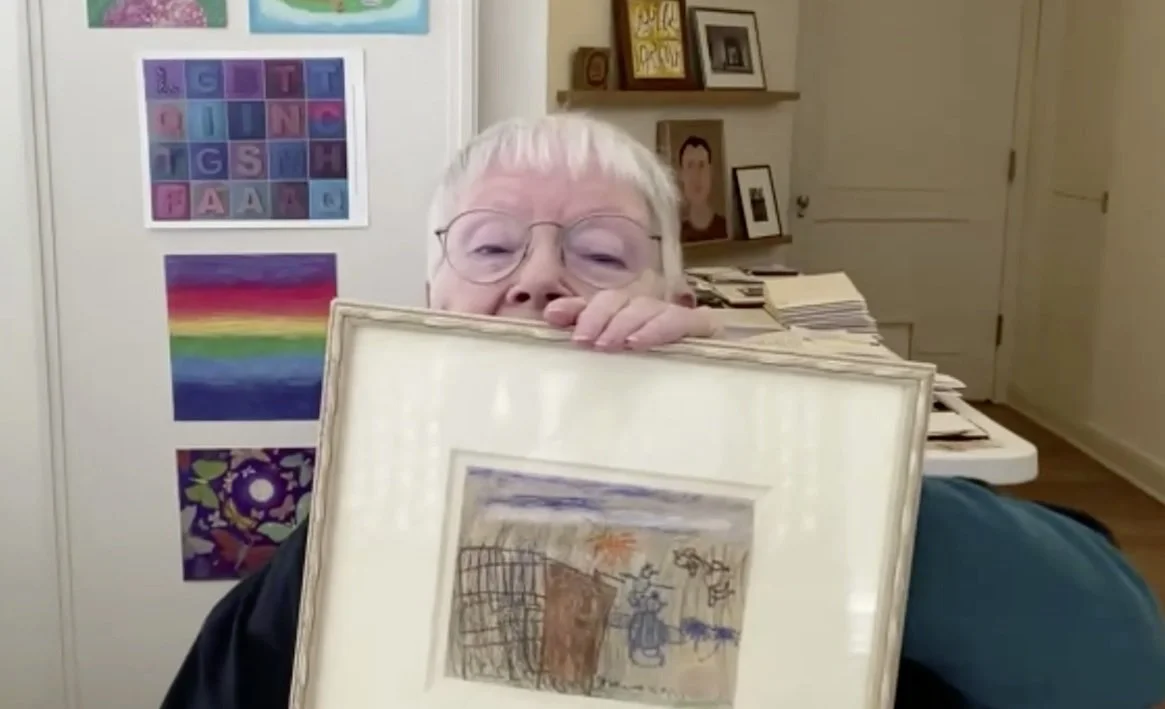
Image: Lee shows us her 1st Grade drawing over Zoom
LLA: And you know what it is? I mean, it's a little hard to decipher. It's birds flying free from a cage, which is what I felt about being in first grade and having a strange teacher and being regimented and everything.
Feeling caged was something that I think a lot of people, particularly people in the LGBTQIA+ community sometimes feel… like they can't be their true selves. It took me many, many years to figure out and to accept what was going on. But it showed up in a way in that early drawing.
And then I wanted to show you one other artwork of mine. At 17 years old, I took Saturday morning art classes that the Philadelphia school system offered. And on the last day of our season, the art instructor said, “I want you each to do a self-portrait, but not just a pretty picture. Show who you are on the inside.” This is a picture of me at 17. I specifically painted myself to be in a box that I could see out of but not get out of. They're interesting historical documents, those two artworks.
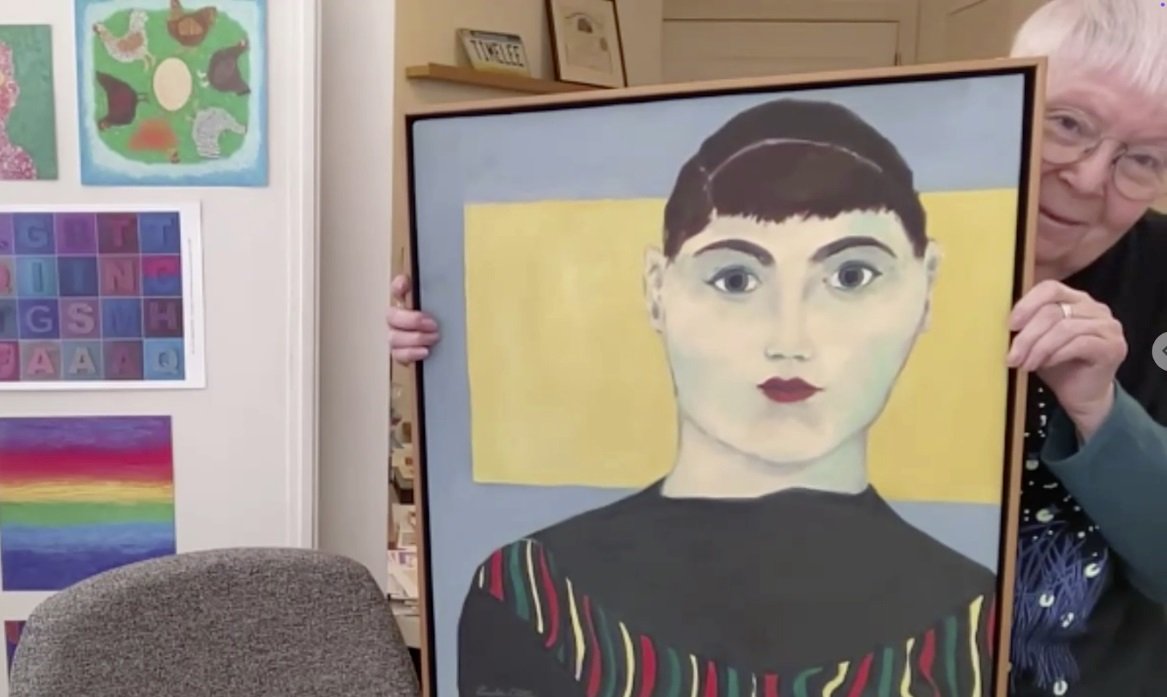
Image: Lee shows us her self-portrait completed at 17 over Zoom
JF: Your collection of women artists, which you donated to PAFA in 2010, must have been exciting to form. Can you describe how you went about forming the collection, and what your process of discovering artists and acquiring work was like? What advice would you give to someone wanting to start their own collection?
LLA: My advice about collecting art is to acquire art you love and want to live with. In my 50s, thanks to my family, I acquired more financial flexibility, and I didn't feel I earned it. I really wanted to find ways to give back so that it wouldn't feel it was wrong for me to have that ability. For a while, I joined art organizations and I served on several boards, but I'm an introvert. I don't like public speaking and I'm not comfortable leading groups of people. But at the same time, I didn't want to just give money. I wanted to somehow use who I was to help others in some way.
In 1980, I began collecting art. At first, I would go to galleries and just pick art that I really loved to live with. And I realized I wasn't seeing a lot of women's art—which of course I should have known already— and I did, but it didn't register as fully. Sometimes I would see art by women in a gallery’s stacks, but they didn't always have it on view. So I decided I would focus on collecting outstanding art by American women artists, art that I loved and wanted to live with. From the start, my purpose was to build a collection museums would want.
I couldn't just build a collection overnight and then give it. I knew it would take me many years to do that. But my focus was on gathering art by outstanding women American artists of various styles and points of view and mediums that someday museums would want.
I collected for 28 years before I felt that the collection was significant enough for art museums to want it. I didn't want to just give the artwork after I died. I wanted to be able to donate the artwork as soon as it made sense to.
With the wise advice of a dear friend and a lawyer, Virginia Sykes, who also helped me start Leeway, and with Michael Lent, my financial advisor and friend, in 2008, we began exploring where would be best to give the collection. It took us about two years of looking, visiting, and talking with people in Philadelphia, New York, and New Jersey. We wanted to find an art museum that would really want the collection of art by women, and would promise to show the work and integrate it fully into their programming. We eventually selected the Pennsylvania Academy of the Fine Arts. I've been happy to have PAFA be home for the collection for the past 15+ years.
JF: It’s an incredible story. And I think it's incredible that it took so long to form, it really shows your care in selecting the work. The collection has so many artists I really adore, and I’ve also been introduced to artists by looking through the collection recently.
You just mentioned the Leeway Foundation, so let’s also discuss your role in founding it. It has been so transformative for artists in the Philadelphia region for decades. Many of our artists that we work with receive funding from Leeway, and we occasionally exhibit projects where artists have received support from the foundation, as was the case with our exhibition that just closed, Arleen Olshan: The Tangle I’ve Gotten Into. What has it been like to see the foundation thrive and continue to support so many incredible artists over the years?
LLA: In the 1990s I was still looking for ways to give back. One day in 1990, a light went off. As an artist, I know how much women artists have been discriminated against and have less opportunities to receive support for art projects. So I decided to create a foundation that would help encourage and support women artists of the Philadelphia area.
With Virginia Sykes' help, Leeway was born. After a number of years, my daughter, Sara Milley, led the Board of Directors. Sara had a broader vision, which helped Leeway become what I would have wanted it to become if I had had that vision. And that was to be much more inclusive. In large part because of Sara, Leeway now specifically includes trans artists in its granting programs, and the Staff and the Board of Directors are composed of people from the community Leeway serves…
Those two things were very important to making Leeway what it is today. Sara and I don't have close contact with Leeway anymore because we wanted it to be on its own. But we are still very interested in the good work that Leeway is doing and very happy how the foundation has evolved.
JF: Awesome. It’s been wonderful to see which artists are supported each year. It’s a great way to map out what exhibitions I want to go to because it’s a great indicator of good artwork happening in Philadelphia.
While browsing the collection on PAFA’s website, I was excited to learn about Ilona Granet’s work for the first time, who is a feminist sign-painter. I’ve loved signs as a medium for artmaking since first seeing the work of Edgar Heap of Birds, and signs are also a part of your own art practice (which we’ve recently added to our Permanent Art Collection). Can you talk a little bit about this body of work?
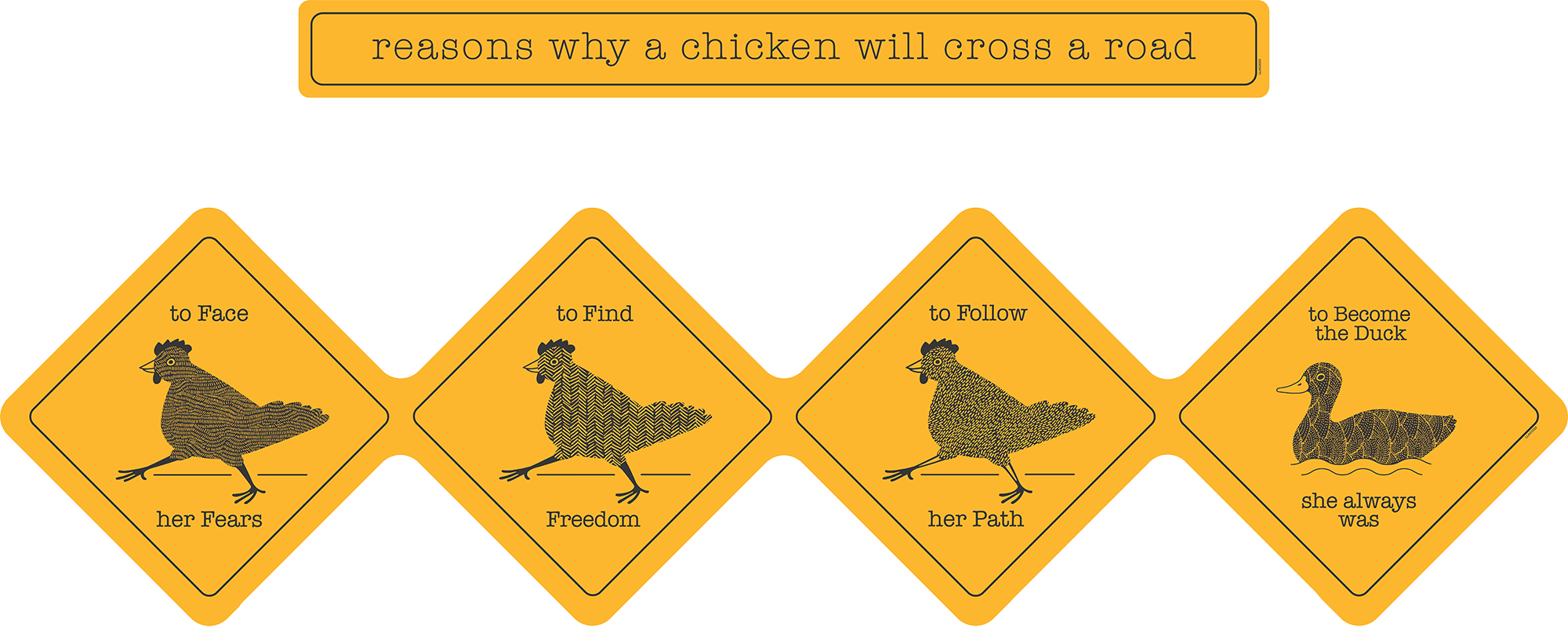
Image: Linda Lee Alter, reasons why a chicken will cross a road, 28.125” x 68.25” two piece sign, Permanent inks printed on film on .080 aluminum, 2022
LLA: As you saw from my first grade picture, my art always has a message… I communicate better through my art than with words. So my fabric appliqué wall hangings, paintings, and sign art all have messages. I'm trying to reach out to people, and often it's about hope, love, peace, and caring for the natural world.
Speaking out through signs, and by participating in rallies, demonstrations, and by other forms of protest is essential right now -- because people who are LGBTQIA+, Black, People of Color, Indigenous Peoples, Jews, and immigrants are all being marginalized. When that happens, it happens for everyone. Like the two people that were killed in Minneapolis, it could be anybody. We are all threatened by the acts of this federal government and the secret army of ICE agents… it's scary as hell.
I've been creating metal sign art since 2018. I have a whole series you may have seen of chickens.
JF: Yeah. Yeah, I love those pieces.
LLA: All the chicken signs had messages. And since this current administration came to power, starting at the end of 2024, beginning of ‘25, I have felt a much greater urgency to make signs in order to get my messages out in public. If I were 30 or 40 years younger, I'd be out there, myself. But at 86, I'd be a hindrance, not a help. I have been making my messages seen by helping other people get their own messages out. And their messages overlap mine and the messages of lots of other people.
In early 2025, I made a PDF of these signs and offered the signs to family and friends, and I just recently sent out another PDF of signs to about 20 people. We're going to try to print them in time for the No Kings March later this month.
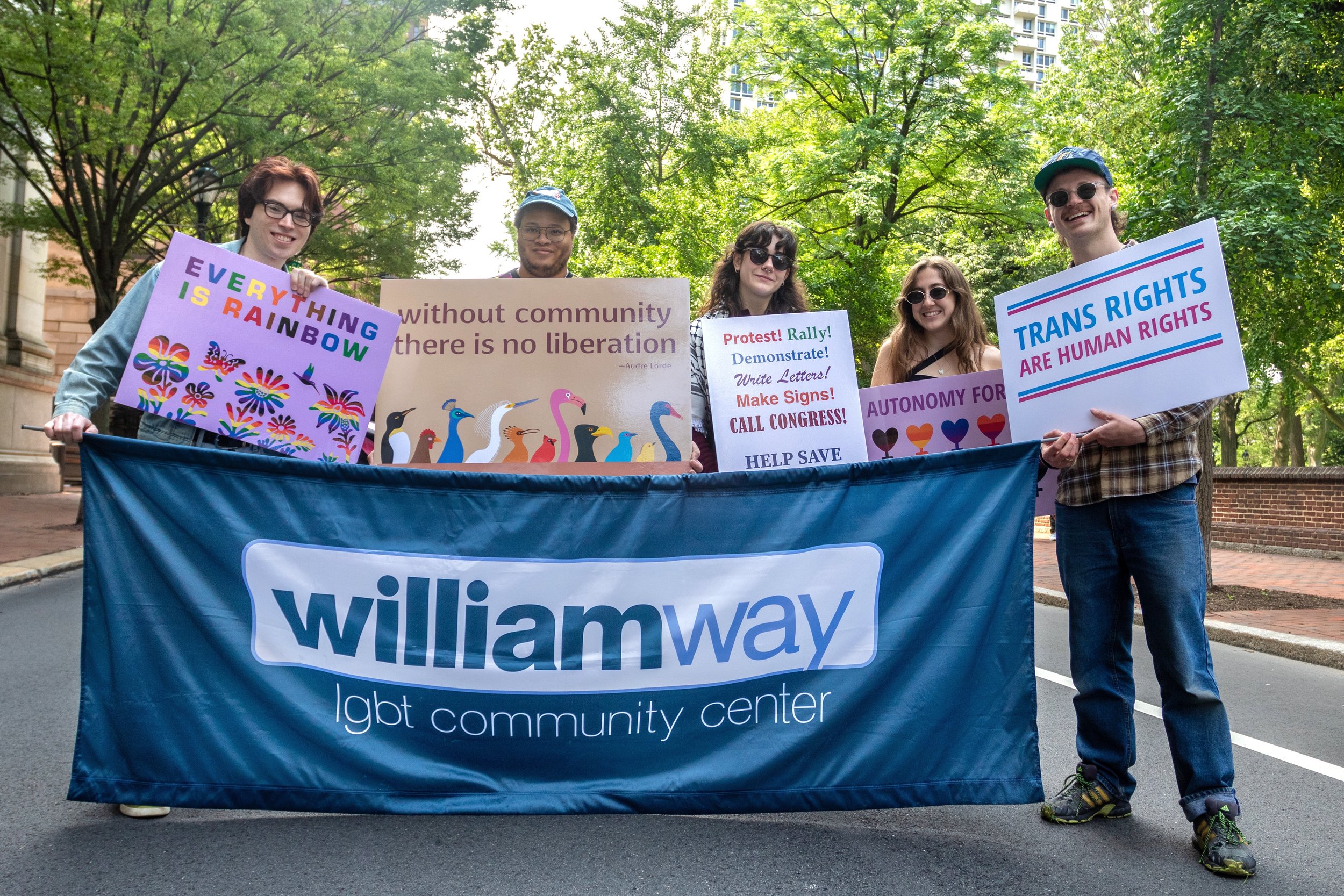
Photo: Signs by Linda Lee Alter held by volunteers and members of our Arts Committee in the 2025 Philly Pride March, photo by Madasyn Andrews
JF: Wonderful. Let’s talk more about your art practice. I’m also interested in discussing your “After Awareness Paintings,” and I think the story behind them will resonate with our readers. Can you talk us through its backstory and the process of development of this work?
LLA: In 2014, at the age of 74, after many years—many years—of working through my confusion and fears and hopes, I finally accepted myself as a lesbian. I wanted to communicate directly about my realization, and as always, my fullest way of communicating was through making art. The five Awareness Paintings were my way of documenting my coming to awareness and feeling fully myself. It was a serious endeavor, but as you must have noticed (as is often present in my art), there's often an element of humor. Humor is a way of reaching people, to not be serious about something, but to be serious at the same time. For a long time, and I haven't said this before, I've been wanting to donate the Awareness Paintings to William Way.
JF: Oh, wonderful!
LLA: But I haven't offered the paintings because I know the Center is in transition now and you don't have as much storage space and everything. Even though each person has their own unique journey, I think images that show my journey can help other people feel more comfortable, and maybe even allow them to be willing to accept who they are more fully. And so I think they could be an important small addition to the collection. Please keep that in mind as time goes on, because I really would like to do that.
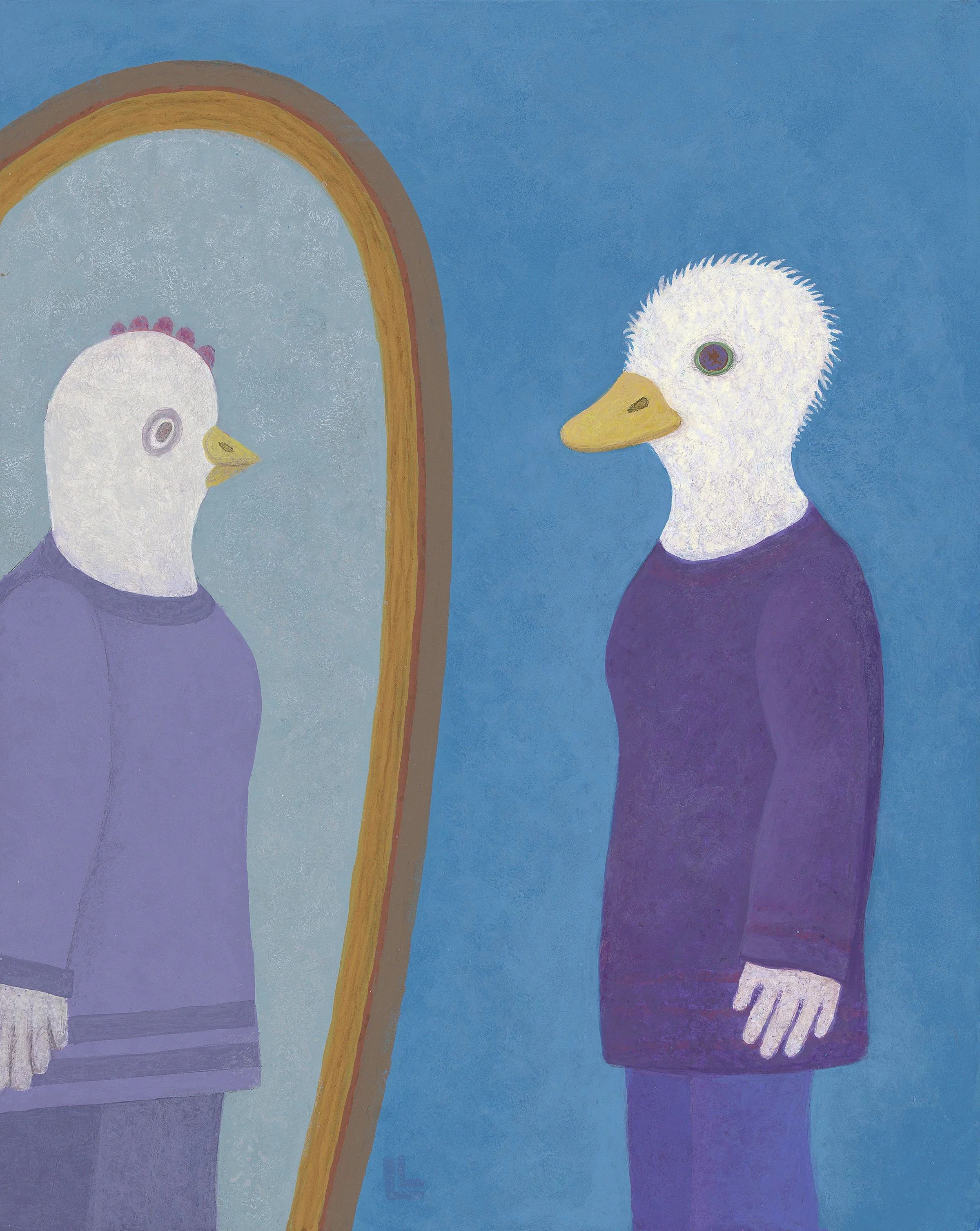
Image: Linda Lee Alter, "If it Acts Like a Duck, Thinks Like a Duck, Feels Like a Duck, it’s a Duck.” 9 x 12” Acrylic on Panel 2014, Collection of The Artist
JF: Specifically, I love your work "If it Acts Like a Duck, Thinks Like a Duck, Feels Like a Duck, it’s a Duck," which I saw in a group exhibition curated by Meg Wolensky last year at the 20*20 House in Lansdowne. The duck kind of looking in the mirror, the chicken and the duck looking back, or vice versa. I think it's really, it's really funny, but it's really, it is so poignant too. You also have a history of working with us at the William Way, where you served on our Arts Committee and volunteered your time and experience to help put together our art exhibitions. What drew you to working with the William Way, and what was your time on the Committee like?
LLA: Well, I always sort of knew about William Way, but kept it at a distance. In 2014, when I came out, I wanted to find a community. Because art is my way of relating, and because I felt, maybe because of my art collection and Leeway, they might be willing to accept me, I requested to join the Arts Committee. I felt very grateful, happy, and relieved to be accepted.
That was when I first visited William Way. The first time I entered the building, my heart was thumping and I was very hesitant, scared, and uncomfortable. I sort of didn't want to be there… but I wanted to be there. I felt welcomed and accepted. Through William Way, I found community and I made good friends.
I think I've received much more from the William Way than I've given. I served on the Arts Committee for ten years. I'm still very grateful to the William Way for welcoming me, and helping me to be who I am.
JF: That's a wonderful story. And I know that, yeah, on the Arts Committee, that was the time Janus Orma was chair.
LLA: And yes. Janus and I met while we were waiting to be brought to our first meeting together. We have become very close friends.
JF: Oh, that's beautiful. That's what I grew to love about the Arts Committee too. Before I was hired, I served as a volunteer on the Arts Committee, just after you and Janus had left. I loved that it was intergenerational and included people from different backgrounds and all parts of our community, who all come together to make our exhibitions happen. Especially on our 50th anniversary, it’s wonderful to acknowledge our volunteers who made our exhibitions happen for all that time. I think that's such a great thing to honor.
LLA: Yeah. I'm very happy you're there making all art related matters happen more efficiently, consistently, and broadly, like with the newsletters, you've really improved that.
JF: Thank you. Thank you. WayOut has really been wonderful to put together with our committee. And it’s nice to sit down with artists and people in the community like this to have conversations that can be documented, just like this. Thank you so much for your time!
To learn more about Lee and her artwork, visit lindaleealter.com
Featured in the Issue 20: March 2026 edition of WayOut, your Philly Queer Arts
Publication brought to you by the Arts Committee at the William Way LGBT Community Center.