
Symone Salib: Arab American Heritage Month Feature
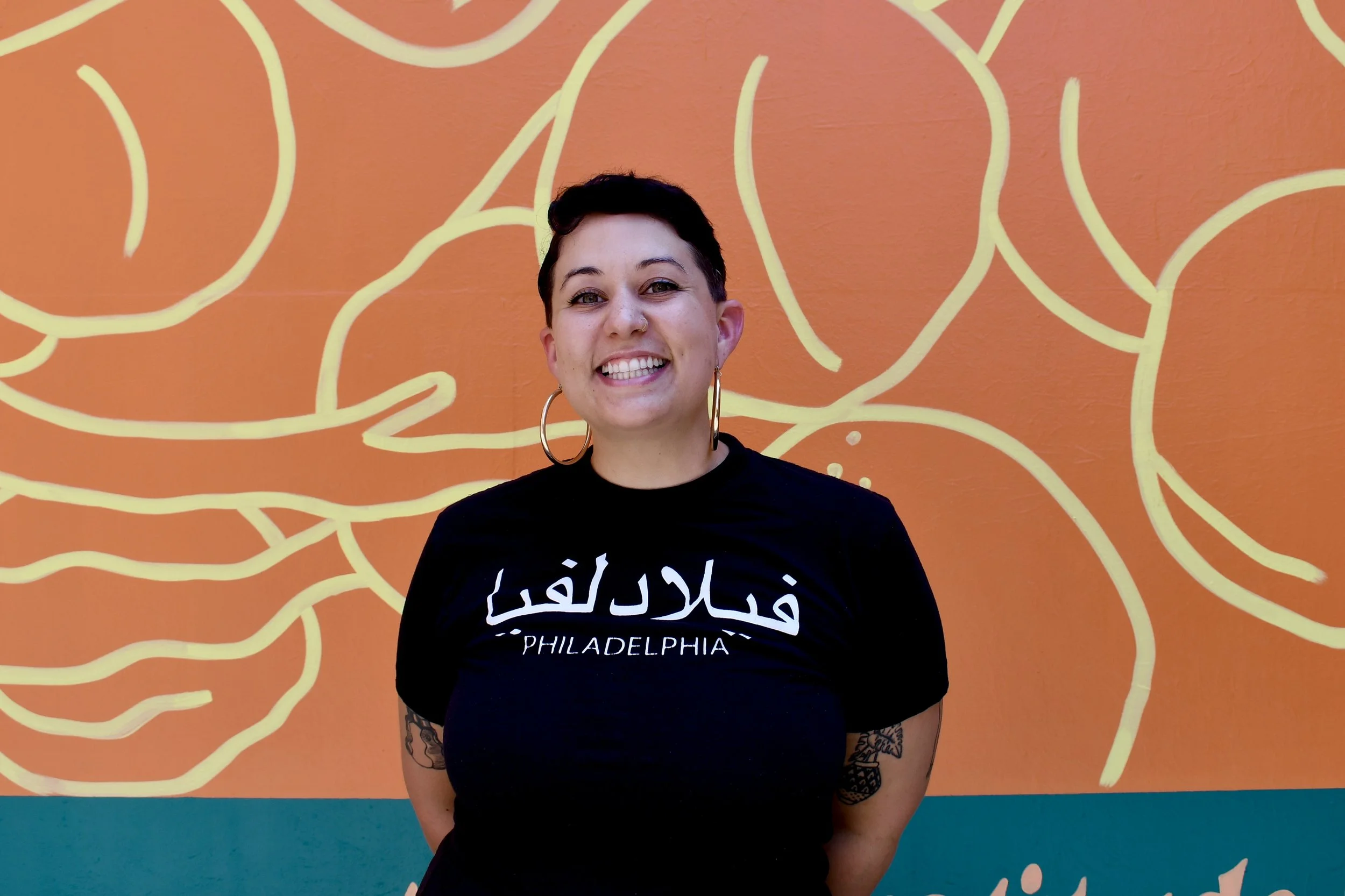
This month, WayOut is featuring Symone Salib (she/her), a first generation Cuban/Egyptian street artist, muralist, and educator based out of Philadelphia. She works to highlight BIPOC and queer individuals through acrylics and wheatpaste, asserting the humanity of black and brown bodies and the necessity for justice against police brutality, sexism, and homophobia. Enjoy this discussion on how Symone explores her Arab and queer identities through her work and how her network of LGBTQ+ friends are a source of joy and community.
Jake Foster: Thank you so much for joining us. I’d love to begin by asking you to introduce yourself and describe your journey to becoming an artist.
Symone Salib: Sure. My name is Symone Salib. I’m a muralist, illustrator, and trauma-informed educator. I love creating work in public space. I think it’s incredibly powerful and often underutilized in the art world. It’s sometimes received differently than fine art, but I think it has its own value.
I’m self-taught and community-taught. I didn’t go to art school—I’m just someone who loves art and loves people. I see art as a vehicle for connection, which is what led me to become a teaching artist. It felt like a seamless transition. I also love working with youth. I feel like they have so many great ideas. It's really inspiring to be able to give people tools and watch the way their world can expand.
Jake Foster: That’s great. It’s refreshing to see someone so active who didn’t come from an academic art background. We need those artists as well.
Symone Salib: There are so many ways to learn. Some things do require guidance, but a lot of knowledge feels gatekept, and I don’t think it should be. Anyone should be able to pick up a paintbrush and express themselves.
There are technical skills you need help with. For example, when I learned sculpture, I needed guidance from people with experience. But I’m a lifelong learner. I'm a curious girl. If I want to do something, I’ll figure it out. Higher education is also inaccessible for many people. I was lucky to go to college, but I’ll never let not knowing something stop me: I ask questions, learn from others, and adapt things in my own way.
Jake Foster: What did you study in college?
Symone Salib: Public Relations and Communication Studies. It actually helps a lot with the business side of being an artist, which often isn’t taught, even in art school. That gap can lead to artists being taken advantage of.
I didn’t expect it to work out that way. I originally planned to become a dentist, but I couldn’t pass pre-calculus—so here we are.
Jake Foster: Sometimes failing at something can be the best thing… it redirects us in the pathway we should go.
I’d love to talk about your style. It’s very distinctive. I’ll be walking around the city and recognize your work immediately. It often involves bold colors and strong outlines, with influences from street art, pop art, and activist graphics. Can you talk about how your style developed?
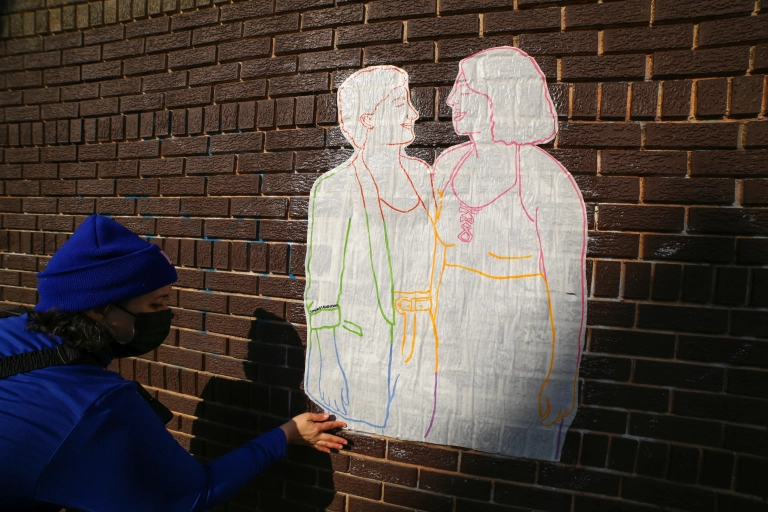
Symone Salib installing a wheat paste for her series “That’s Gay” (2022)
Symone Salib: I think it's really hard to find your niche. Many of the artists that we love have recognizable work, and I asked myself “how do I do that?” I found that in the early stages, it’s important to be open to exploration and continuously evolving. For me, that journey started as a street artist.
I love the medium of wheat paste, because it’s something that’s so accessible. Printmaking is great, but it’s not always easy to do at home, and I worked out of my house for a long time.
I remember when I was in school for PR, they talked about how people digest information, and it made me think, “When you’re passing by, how much time does someone have to really take it in?” I wanted the things that I made to be accessible to digest—like a short, concise phrase— that makes you have a moment of critical thinking. I’m very intentional about the design elements… there’s something about simplicity that feels really special
I've always been someone who's made art—I’ve always been someone who’s had a sketchbook and love to paint. Then I moved to Philly in 2015, and I put my first piece of street art up in Summer 2017. The next year was when I really started to run around outside with my art practice… learning and figuring it out as I went.
Jake Foster: Wonderful! I think Philly is the kind of place where there's lots of DIY culture. It doesn't feel competitive… there's lots of skill-sharing and encouragement in the arts community.
So our Arts Committee chose you to feature this month for Arab American Heritage Month. I'd like to talk about some of your work that draws from your Egyptian heritage. Specifically, I remember your exhibition several years ago at Paradigm Gallery, The Weight of Patterns, which I think was my first introduction to your work.
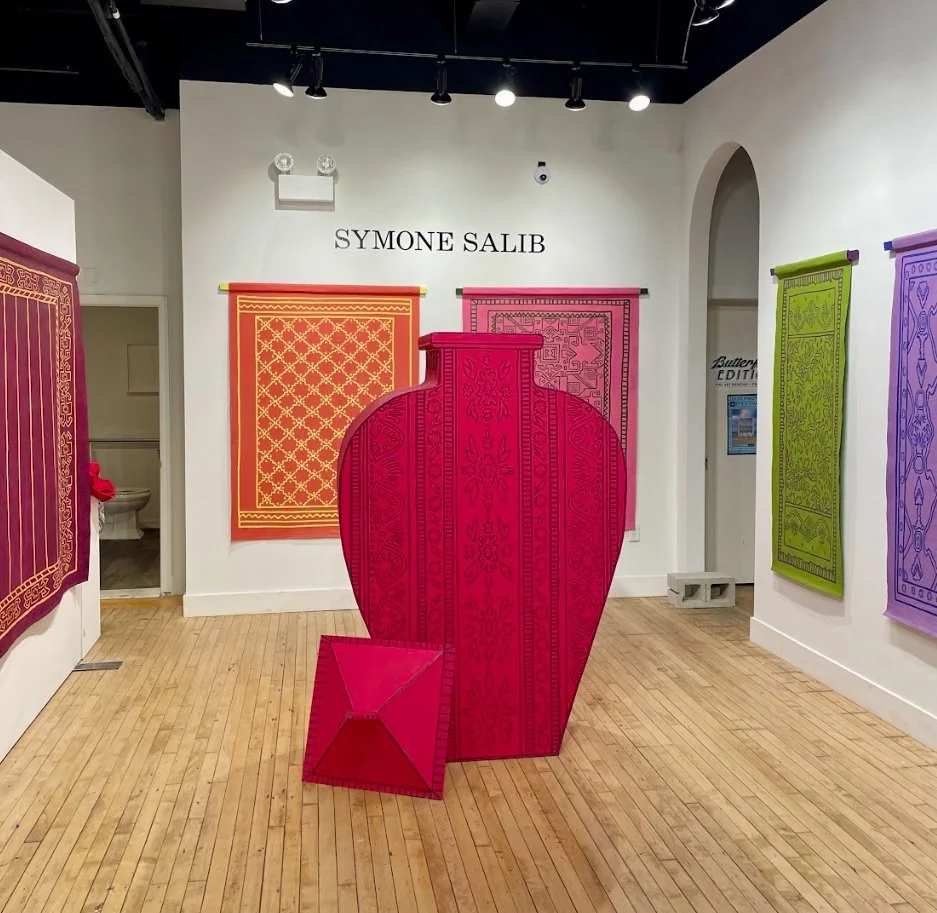
Installation shot of “The Weight of Patterns” by Symone Salib at Paradigm Gallery, December 2024 — January 2025
Symone Salib: First of all, I have never been celebrated during Arab American History Month. I would like you to know I feel very special to be here. It’s definitely a big part of who I am as a person, so thank you for recognizing that. I also feel very protective of my Arab identity, specifically with my art. There are a lot of stereotypes that exist about Arab people across the world, and I think we carry heavy things with us. I was never going to make a body of work or make something that ever did a disservice to my culture or could lend to a stereotype that people on the outside would participate in.
The Weight of Patterns was a way for me to work through the ways we inherit beautiful things from our cultures and carry them with us. And we also inherit things that are hard and feel heavy. We all have generational trauma as Arab people. What does it look like to reevaluate that? This whole body of work was centered around that question.
I took some classes with the Bartell Foundation a few years ago on trauma-informed facilitation practice for teaching artists, which gave me so much language to understand what I wanted to do. There was an incredible facilitator; Dr. Meagan Corrado, who discussed how teaching artists can provide a container for our participants to put their trauma in through artmaking. It doesn’t have to visually represent what we’ve gone through, but it can be this thing that holds their experiences and gives them the opportunity to move through it.
So I made a literal container, an actual vessel, that people could write something down and release into anonymously. It was the first time I made a sculpture, which was really special. It was empowering to work with an incredible fabricator, Kelly Cave, who taught me how to use the power tools. The scale of the sculpture, 5’5”, was intentional, as that’s my height. My body was the scale for all the artwork in the show, including the textile works on the wall.
I had also made paper with a friend of mine, Candy Gonzalez, who is a paper-maker by trade and went to school for it. So I covered the outside of the vessel with a paper clay recipe I developed. The paper clay was made from intentions folks had done in classes and community workshops… so there was a lifecycle of the project, and it felt like a metaphor for vulnerability. The fibers of the paper notes intertwined, and it felt so poetic.
Looking back on it, I’m proud because it feels like such a huge part of who I am. It was also so different from anything I'd ever done before. So much of what I make is people-focused, and this still was, but in a more abstract way—even though there were no portraits.
Jake Foster: Wonderful. Speaking of your portraits, I’m recalling your work featuring a portrait of Gloria Cazares (1971-2014), Philadelphia's first director of LGBTQ Affairs. So in addition to your Egyptian and Cuban heritage, you also celebrate Philly’s queer community in your work. Can you talk a little about that aspect of yourself and your art practice?
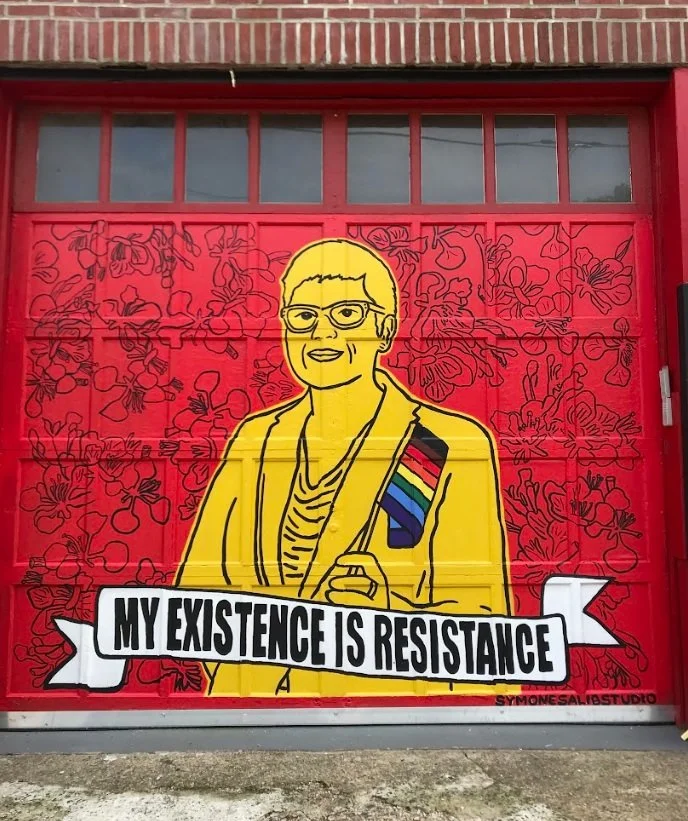
Symone Salib’s mural of Gloria Casarez at GALAEI (118 Fontain Street, Philadelphia, PA 19122)
Symone Salib: I feel like I’m so many things as a person. My heritage plays a big part in who I am, my understanding of the world, and my values. At the same time, my queerness plays a large role too.
I often think about who are the people that are represented, and why? And if I have a choice in who I’m painting, I’ll always pick someone who is queer, people who are marginalized, and women. Whenever I walk into a new space and don’t know anyone, I always look around the room for someone I can trust, just going off my own intuition. And more often than not, I seek other queer folks. In this way, my chosen family has been something I’ve cultivated throughout my life… and I get that back tenfold and it feels so special. Philly is really special for that reason. I love our beautiful gay city.
Working on the Gloria Casarez piece was so special because it was right after the original mural by Michelle Angelo Ortiz had been painted over. I worked with GALAEI and The Philadelphia Latino Arts & Film Festival to paint a mural at GALAEI’s building, which is special because Gloria had worked there for so long.
Jake Foster: That perfectly segues into my next question. You have many friends which are also queer artists and organizers in the city. I’ve bumped into you often at exhibition openings, and you always seem very social and community-oriented. Can you talk a little about being in community with queer folks- and how it affects your work and life?
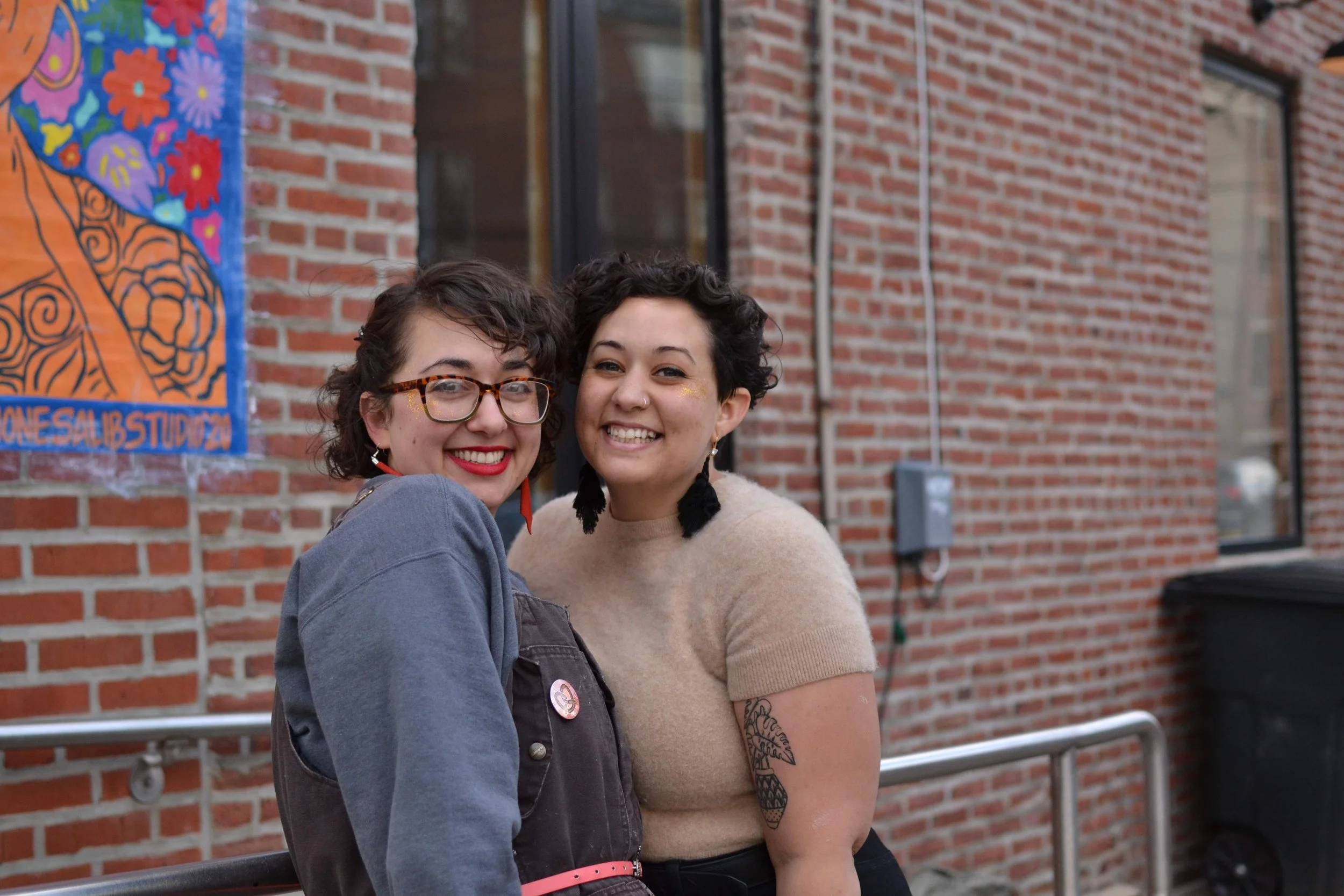
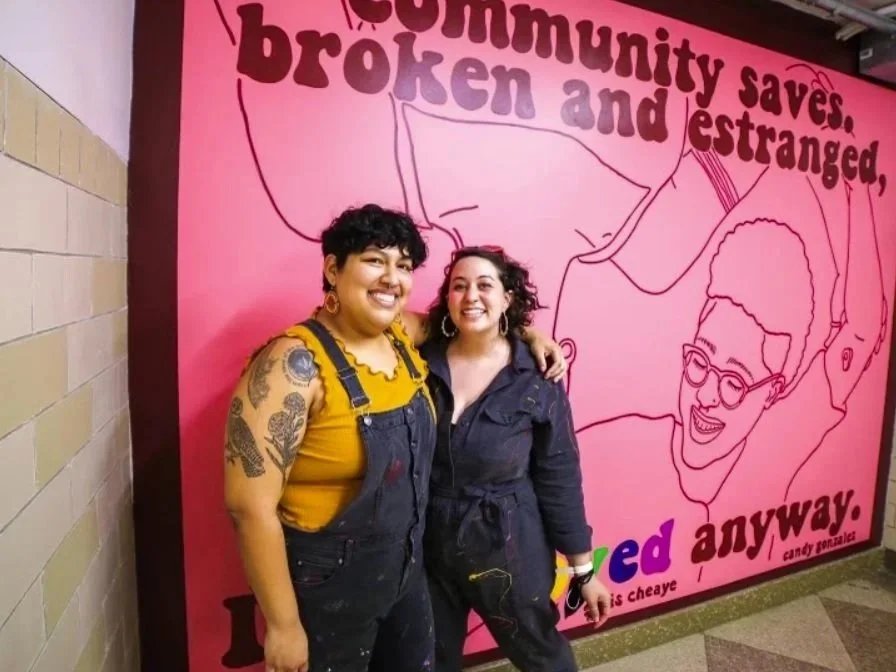
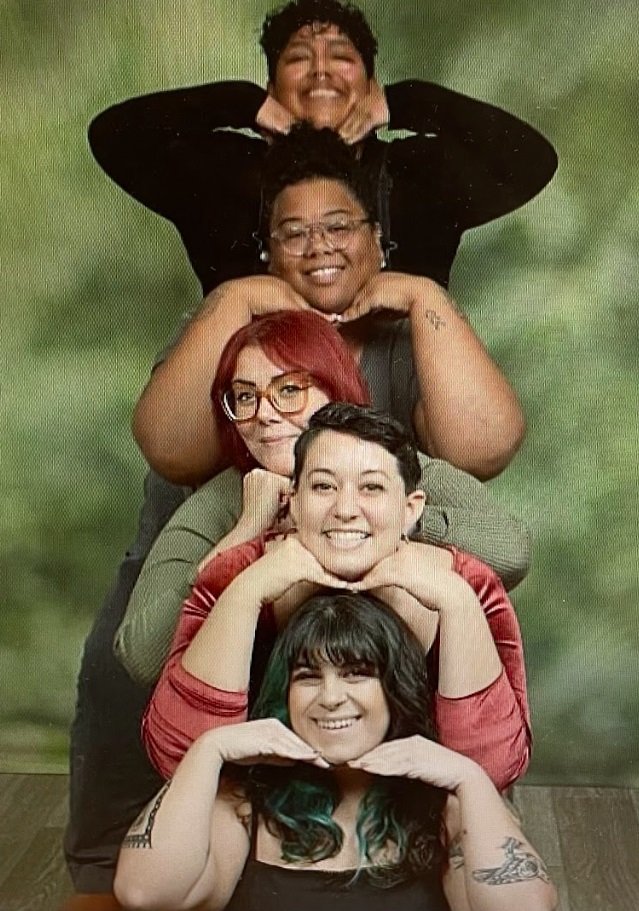
Symone Salib: That is something I'm really intentional about. I'm a curious person, and I like to get to know people. Being in community with queer folks in the city is a beautiful part of living in Philly.
I also love platonic love. I think it’s so special and should be celebrated more. If I meet someone and think they’re cool, I like to invite them over for dinner. I didn’t grow up in a space where we ate dinner together at my house that often, and I love to have people at my dining room table… It's a special place to be. Art is a vehicle for connection, but I also love to cook. I think being hospitable is a natural part of who I am, and I feel like that’s part of my Arab identity I take with me.
When I first started doing art in Philly, I didn’t know anyone. Once doors started opening for me, I felt like I had to be the person to leave the door open for someone else too. If I meet someone and can’t do a job someone’s asking me to do, I pass it on to someone I know would be great. There are enough opportunities for everybody, I don’t believe in having that scarcity mindset in the arts.
I know I can lean on the community I’ve built over the last 10 years in Philly if I’m having a hard time, and they would do the same for me. My friend Sandy calls it art karma.
Jake Foster: And I also feel like being a part of an art community, it's like, you want to show up for other artists and get their exhibition openings the same way that you want to see them at yours.
Symone Salib: And people remember that stuff. I remember that stuff. When I have been in the throes of a big hard project and I'm like, I'm drowning, I know that I could call certain people and they would help me. And I've done the same.
Jake Foster: Awesome. As my last question, and on the topic of big projects, I'm wondering if there's something that you've been working on in the studio or anything coming up that you'd like to share?
Symone Salib: I’m going to be offering more art classes out of my studio in the Spring. This past year, I moved into a larger space in the Bok building that I share with two studio mates. I want it to be a space where people can create and have a moment for connecting with one another. I’m also working towards a big mural project this Summer, but I don’t want to talk too much about that just yet.
To learn more about Symone and keep up to date with her projects, see her Instagram, @symonesalibstudio.
Featured in the Issue 21: April 2026 edition of WayOut, your Philly Queer Arts Publication brought to you by the Arts Committee at the William Way LGBT Community Center.
Read our full newsletter here. To get our monthly email directly in your inbox, subscribe here.